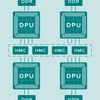
Silicon Valley's newest chipmaker, Wave Computing, came out of stealth mode this week, announcinga family of computers purpose-built for deep learning. The new systems are powered by the Wave Dataflow Processing Unit (DPU), a massively parallel dataflow processor designed to optimize the learning models. According to the company, the technology performs an order of magnitude fasterthan GPUs or FPGAs and is more energy efficient.
A team of scientists at Delft University of Technology in the Netherlands have developed a technology that uses chlorine atoms to read and write data, enabling extremely dense storage to be constructed. The prototype device can store just a single kilobyte of data, but if it was scaled up to one square centimeter, it would have a capacity of 10 terabytes.
Japanese IT conglomerate SoftBank announced it is buying ARM Holdings, the UK-based microprocessor designer, for 23.4 billion, or about $32 billion. The deal came as surprise to many tech industry followers since until now SoftBank has played mainly in the mobile telecom space, with forays into internet services.
More than a hundred high-profile leaders from Silicon Valley and the broader IT community have published an open letter warning voters that a Donald Trump presidency would be a catastrophefor American technology leadership. The letter was signed by 145 inventors, entrepreneurs, engineers, investors, researchers, and business leaders working in the US technology sector.
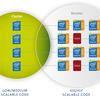
The European Union is funding a number of HPC projects that are exploring different hardware and software technologies for exascale computing. One of these, known as DEEP-ER, expands on the notion of the Cluster-Booster architecture of its predecessor, the DEEP project. Using a mix of European HPC technologies from German, Italy and elsewhere, DEEP-ER is exploring some of the thornier issues of exascale, in particular, I/O scalability and system resiliency.
Addison Snell discusses the potential ramifications of Brexit on the HPC industry with special guest Andrew Jones, HPC Consulting Team Leader at Numerical Algorithms Group.
A report by CRN says that VMware is developing a high performance computing service usingthe companys vCloud Air IaaS platform. According to the report, the new service will be aimed at large enterprise customers. Thestory was based on three unnamed sources that had been briefed on the product.
The Federal University of Rio de Janeiro (UFRJ) has deployed a 226-teraflop SGI ICE X supercomputer to support engineering and research projects aimed at the Brazils energy industry. The system will serve both commercial and academic interests from its new home in the universitys High Performance Computing Center at the Graduate School of Research and Engineering (COPPE).